Thursday, 13 October 2016

Award Winning Walking in the Park

"It's too bad," says Gary with a grin upon his face, "that there isn't an award for the untidiest desk or the tallest pile of Racing Calendars."
 
He is referring to the fact that his team has just been named as the winners, in the jumps track category, of the 2016 racecourse Groundstaff Awards. It's also true that there is a stark contrast between the neat enclosures outside my office window and the organised chaos of the Stewards Room, which doubles as managerial HQ when we're not racing.
 
As I've always maintained, a dirty bath is the sign of a clean body and a tidy desk is the sign of an empty mind.
 
Nonetheless, Gary Sharp's achievement, at the head of a team consisting of one other full-time groundsman (the excellent Martyn Fogg), plus several part time staff and contractors, is significant. His efforts have yielded record numbers of runners, greater consistency in the going and several innovations that have improved both the racegoer experience and equine safety. 
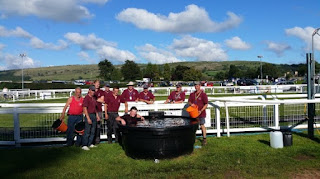

Racehorse trainers have responded by sending better horses to Cartmel; it's no accident that two track records fell during the course of this year.
 
An interesting fact: we welcomed more horses to Cartmel during the first six and a half weeks of the most recent season, than in any calendar year of the racecourse’s history with the exception of 2015. Repairing the track after so many hoof prints is no walk in the park. Well… except of course it does involve walking… in the park. But there’s lots of other technical things that Gary does too, besides the walking – or so he tells me.
 
I think he gets many of his ideas from Pitchcare magazine, which happens to be one of the brand-sponsors of the award - alongside Fornells, the running rail manufacturer, and Watt Fences, who supply materials for making hurdles, steeplechase fences, PVC fencing and almost anything else you could want on a racecourse except barbecues and cricket bats (which, apart from Cartmel, aren’t required at most racecourses anyway).
 
The team at Brighton picked up the groundstaff award for Flat tracks, while Ascot scooped the award for dual-purpose tracks (flat and jump combined). The overall winner, for the top team of the year, will be announced at the Racecourse Association’s Showcase Awards next month – an event which is a bit like the Oscars but much more important.
 
If there was an award for the top racecourse tipster (there isn’t), we might have been in with a chance this year – the weekly selections have so far yielded a profit of £49.29 to a £1 level stake. Realism suggests that the good fortune can’t continue – but we’re going to give it a go anyway, with Rayvin Black in the 4.10pm at Kempton on Sunday.

Friday, 7 October 2016

Glass Half Full

Each year, at about this time (Friday evening to be precise), we stage an annual get-together for the people that have helped us throughout the season. It’s a fun occasion and it gives us a chance to reflect on the events of the Summer.
 
I’ve come to notice over the years that when a Clerk of the Course makes a mistake, we have a new track layout; when the office administrative team makes a mistake, we have a new filing system – but when I make a mistake, it turns out that I’ve just made a mistake. Well on Friday evening I’ll be reminded of all the new ideas that the team has come up with and all the mistakes that I’ve made during the year. We’ll have a chat and a laugh, we’ll make some fresh plans and we’ll raise a glass to the season that’s passed. And, at the very least, the glass will be half full…
 
Because there are a multitude of benefits to be derived from positive thinking. According to research scientists at the University of Kentucky, optimists are likely to have a stronger immune system than pessimists, they’re at a lower risk of heart failure and they’ll live for longer. Optimists are also more likely to age well, which explains why so many racehorse owners appear to be so spritely in the Parade Ring - because there can be no greater optimist in the World than a racehorse owner.
 
And of all the varieties of racehorse owner, there can be no greater expert in positive thinking than those that own jump horses – and of all the months in the year, October is the time when their optimism hits peak levels. This weekend's Totepool Silver Trophy at Chepstow has long heralded the start of the Winter jumps season – with the unleashing of some of the most promising horses from the most prolific yards. The meeting has been through a quiet spell for a decade or so, but this year it has regained its lustre – with Saturday’s £50,000 prize attracting a high quality field and supporting races for the two-day meeting attracting some of racing’s biggest names.
 
Former Champion Chaser Sire De Grugy could run at the meeting, as well as the Cheltenham Gold Cup fifth Irish Cavalier and Grand National candidates Unioniste and Kruzhlinin. However, if there is one horse that I can’t wait to see this Winter, it is the full brother to Wishfull Thinking – this week’s selection: Wishfull Dreaming.
 
Call me an optimist, but if this horse can't win off a handicap mark of 123, I'm a Dutchman (and I'm pretty sure I'm not). If I’m wrong? Well, I’ll just have to console myself with the fact that I’m going to live longer than most of the pessimists believe... possibly in Holland 

Thursday, 29 September 2016

Down in the Mouth


I’m feeling pretty down in the mouth at the moment. In fact there is no depth to which the down-ness in my mouth won’t plunge and there is no limit to the self-pity that I can heap upon myself. And nothing that you can say will make me feel any better.
 
Take, for example, the people that I heard yesterday, complaining about the long queue they’d endured at the dentist… while I was in the chair. Who would you rather be, the person sitting in the dentist’s chair or the one sitting outside on the comfy sofa, listening to Lakeland FM with a choice of newspapers to hand?
 
I had a tooth extracted. It took hours. Or it seemed like hours – long enough to ensure that every other patient was going to be at least forty minutes late throughout the rest of the day. I knew I was in trouble when the dentist turned to the dental nurse and asked for a new drill bit and a larger pair of pliers. About twenty minutes later he said "This one’s a bit stubborn isn’t it". And twenty minutes after that he explained "I’ve got most of it out now; we’ll get that last bit next time, when you come back for the implant."
 
And have you seen the cost of dental implants recently? For the price of one implant, you could keep a horse in training for two months with most trainers. Although probably not with Willie Mullins, which is apparently the reason why Michael O’Leary has just removed around sixty horses from the Irish maestro’s yard. Apparently there was a disagreement over the cost of training fees and Michael O’Leary, the owner of Gigginstown Stud, needs 120 new teeth… per month. Or something like that.
 
Anyway, I can’t feel too sorry for Willie Mullins, nice chap though he undoubtedly is, because he still has lots of very smart horses to train – and unless he tells me otherwise, I don’t think he’s had a tooth extracted this week...

I don’t feel particularly sorry for the multi-millionaire Michael O’Leary either, although I’d wish him all the luck in the world - if he'd just send a few of those sixty horses to some of our local trainers in Cumbria. How much fun could he have with horses like Blow By Blow and Apple's Jade, if only they were trained by the likes of James Moffatt and Diane Sayer?
 
Perhaps Dan Skelton, in the south of England, will get one of the Gigginstown horses instead – he already trains this week’s selection: Zarib at Fontwell Park on Saturday. I’m sure he wouldn’t look a gift horse in the mouth, which reminds me – did I tell you that I’ve had a tooth out this week?
 

Friday, 23 September 2016

The Final Act

All good things come to an end: Angelina Jolie & Brad Pitt, Brad Pitt & Jennifer Aniston, Angelina Jolie & Billy Bob Thornton - not to mention Jonny Lee Miller. And then of course there's the Horserace Betting Levy Board.
 
The Levy Board is the statutory body which oversees the collection of funds from the off-course betting industry and distributes it throughout the racing industry, predominately through contributions towards prize money. The Government announced, in March this year, that it planned to bring in a levy replacement system from the beginning of April 2017, designed to cope with the shifting sands of betting trends - specifically the drift of money from highstreet betting shops to digital platforms administered from offshore jurisdictions, where the levy doesn't currently apply.
 
Having lasted for more than five decades, the Levy Board has already demonstrated greater longevity than most celebrity marriages - despite similarly regular and premature reports of its demise. But, with further Government announcements expected within the next few weeks, it looks as though the final act of the levy drama may now be unfolding - and it's got racecourse executives sitting on the edge of their seats.
 
Perched behind their desks, this is the time of year that Clerks of the Course formulate their race programmes for next year, a key ingredient of which is the amount of prize money available for the connections of horses. It's an important process because when a horse like Spark Plug wins the Cambridgeshire (this week's selection) the money filters down to all layers of the sport - through owners to trainers, jockeys, breeders, stable staff and a cast of equine suppliers that would extend to horse dentists and physiotherapists (but not quite as far as Mr Pitt's stylist or Ms Jolie's assistant hair-dresser).
 
Despite the fact that all prize money passes through to the horsemen, the distribution of prize money grants is material to racecourses too - because it helps to determine the shape and quality of our race programmes. High prize money doesn't exactly guarantee box-office success but, like a low budget movie, it's more difficult to make an impact if the actors aren't being paid.
 
The average prize fund at Cartmel this year was our highest ever, at just over £7,500 per race. We'd love to pay our actors more, but Cartmel receives less levy funding than any other racecourse in Britain. More than 58% of our prize money comes from our own resources, the highest percentage contribution of any jumps racecourse in Britain and well above the national average of 46%.
 
The discrepancy centres around the fact that, despite their popularity, three of our race-days (one third of our fixture list) attract no levy support at all. That's why, in addition to a levy replacement system, we're looking for a change to the mechanism for distribution - one that recognises the aspirations of racecourses to progress and develop their businesses.
 
Racing has asked the Government to restore the funding pot to the level that it was before the offshore drift commenced: more than £100 million. The problem is, with barely six months to go until the scheduled closure of the Levy Board, we don't really know when we're going to see any action, or even if the Director is about to shout 'Cut!'.
 

Friday, 16 September 2016

A Star is Born

Once upon a time there was a racecourse manager. The racecourse that he ran was very small and had a tiny number of fixtures. But even so, he couldn’t manage it on his own - he needed a team to help dispatch all the tickets, to mend the track, hire the mobile toilets and so on and so forth.

So the racecourse manager hired some pixies. The chief ticket pixie was called Naomi and, because she was always nice to everyone, within a very short period of time she attracted a great number of friends and admirers. Chief among Naomi’s many admirers was Andy – whom she coincidentally started dating during the same week that she started working at the racecourse. The stars, they were aligned.

And so it came to pass, that instead of completing essential work ahead of Cartmel’s final race-meeting of the season in August, Naomi was absent on maternity leave. The other pixies in the office worked day and night - mainly responding to correspondence regarding Naomi's condition, but occasionally selling a few tickets too. There was no grumbling about the heavy workload - or at least not all the time - because everyone was excitedly waiting for the arrival of the new baby (or pixel – as babies are known in pixie land, on account of their small size).

The day of the final race-meeting arrived, but the baby did not; still the requests for baby news flooded the racecourse office. And then, during the week after racing, under the star-sign of Virgo, baby Sasha Seren Williams was born.

Sasha will understand the importance of her star sign, because Seren is the Welsh word for 'star' - and Virgos have a reputation for paying attention to small details like that. They are loyal, kind, analytical, hard-working and practical. They can also be a bit shy and overly critical of themselves and those closest to them - which shouldn't concern her mother too much because, for as long as Naomi has worked in the office, she's never been known to make a mistake - or at least no more than the rest of us. At least not many more; not really bad ones anyway.

Virgos are among the most careful signs of the zodiac; they are not particularly prone to gambling - so when Sasha grows up she might be disappointed to learn that I haven't bought her a cuddly toy, or one of those musical mobiles in the shape of a multi-coloured elephant. I've put a fiver each-way on this week's selection instead. Think of it as an early lesson in life.

And as for the selection - forgive me if you sense an element of déjà vu: I've tipped the Jim Goldie trained Jack Dexter for the Ayr Gold Cup in previous years without success. What can I say? I think he's well weighted and I'm convinced that Jim will win the race one day - it's written in the stars.

Thursday, 8 September 2016

Shades of Grey


According to research conducted by the Equine Research Foundation in California, nearly ten years ago, horses find it difficult to distinguish between items which are red, yellow, orange or green in colour.
 
So, if you were to take your horse to the Holker Chilli Fest on Saturday or Sunday this weekend, it is unlikely that he (or she) would be able to distinguish between any of the chilli peppers on display without tasting them – which isn’t necessarily recommended.
 
If you’re a certain type of person, it’s possible to generate quite a lot of pleasure from watching people writhing in pain whilst eating the fiercest chilli peppers on the planet – if you’re one of them, don’t miss the chilli eating contest each afternoon from 4.oopm onwards. For the less sadistic, there’ll also be trade-stands featuring cuisine from around the world, local food suppliers, music, street entertainers and belly dancers.
 
Fortunately for horses, it appears that they can distinguish blue colours – which, among other things, explains why they can read the blue signage which prohibits them from using the motorway. They can also see different tones of colour – which is probably how they recognise their jockeys in the Parade Ring, although some colour combinations are clearly better than others.
 
Take, for example, Harrison – who is due to run in Saturday’s Doncaster St Leger, sporting the green silks with pinky-red stars of racehorse owner Tim Radford. While familiar to many jumping fans as the same exciting colours seen aboard Somersby and Sgt Reckless, to Harrison they will simply look rather dull and greeny-grey. Meanwhile, Maths Prize (running later on the card) will have no problem picking out his owner’s colours: Her Majesty the Queen’s silks are among the easiest to identify - being purple and scarlet with gold embroidery, a black cap and a golden tassel.
 
In a bid to help racehorses further, the BHA has announced plans to release six sets of never-before-seen racing colours – to be sold through an online auction ending on Friday 23rd September. The new designs stand out as distinct from the 14,000 sets of colours which have already been registered by owners – with symbols like anchors and horse-shoes which aren’t usually permitted. There are also vibrant combinations of colours in rainbow designs and large multi-coloured spots.
 
Each specially-designed set of colours will have a minimum reserve of £5,000 in the auction, with 5% of the proceeds being split between the Racing Welfare and Retraining of Racehorses charities. The remainder of the income will be targeted by the BHA at initiatives to promote racehorse ownership.
 
We can’t say how this week’s selection perceives his name – but I expect Red Pike to brighten up a grey weekend in the Portland Handicap at 2.35pm on Saturday.
 

Thursday, 1 September 2016

Binning a Tradition

We’re big on traditions at Cartmel: the Bank Holiday fixtures in May and August, Taylor's Funfair in the centre of the Course Enclosure and Sticky Toffee Puddings for all the winning connections.
 
Many of our racegoers have their own traditions too: family picnics from the boot of the car, a walk around the village before the first race or a meal in one of the pubs in the square after the last one. Regular visitors have their favourite places to watch from – and some turn up as early as 7.00am in the morning to secure a parking space near the running rail, lighting up the barbecue for breakfast, lunch and tea.
 
The blessing of the horse, part of Sunday’s Steeplechase Service, may only have started fourteen years ago – but it already has the feel of an age-old tradition with many of the congregation attending year after year. It’s even becoming a bit of a tradition for Jimmy Moffatt to win the Cartmel Cup, after three consecutive seasons, and for racehorse-owners Keith and Helen Bowron to bring the large double-handled cup to the Priory to count their blessings the following day. It’s a tradition they’re keen to maintain as it helps to cut down on house-work; apparently when the trophy gets returned to the racecourse, for a few days in August, it leaves an unsightly, un-dusted, ring on the side-board.
 
I’ve noticed that some other sports have cost-cutting traditions - that I’d be quite interested in adopting. For example, during the gaps between polo chukkas (the chukka is the period of play) spectators are invited to walk on to the pitch and tread in the divots, Some polo clubs even advertise ‘divot stomping’ as one of the main attractions of the game: ‘a wonderful way to socialise while helping the groundsmen to flatten the turf’.
 
Most racecourses don’t allow members of the public on to the track, although at Cartmel it has long been the norm for children to play football and cricket between the steeplechase fences. How much more useful would it be if they could be persuaded to tread in divots instead?
 
The bookmakers have a tradition – of ripping up the successful betting slips and throwing them on the floor – which has led, over the years, to many racegoers doing the same thing with their losing ones. The litter from this Bank Holiday weekend has already been painstakingly picked by our litter-pickers and taken away by Wicks Waste Management (who recycle 100%), but I can’t help feeling that the littering of the racecourse is one of the few traditions I’d like to stop.
 
... Unlike my traditional weekly tip – which will doubtless prove unstoppable: Kentford Heiress at Fontwell Park on Sunday. Win or lose, may your betting slip find its way to a suitable bin.